
Development board
Galaxia® Space Development Board
Space development board for demanding space applications requiring low power, high performance, and low single-event upset rate.
Technical specifications available
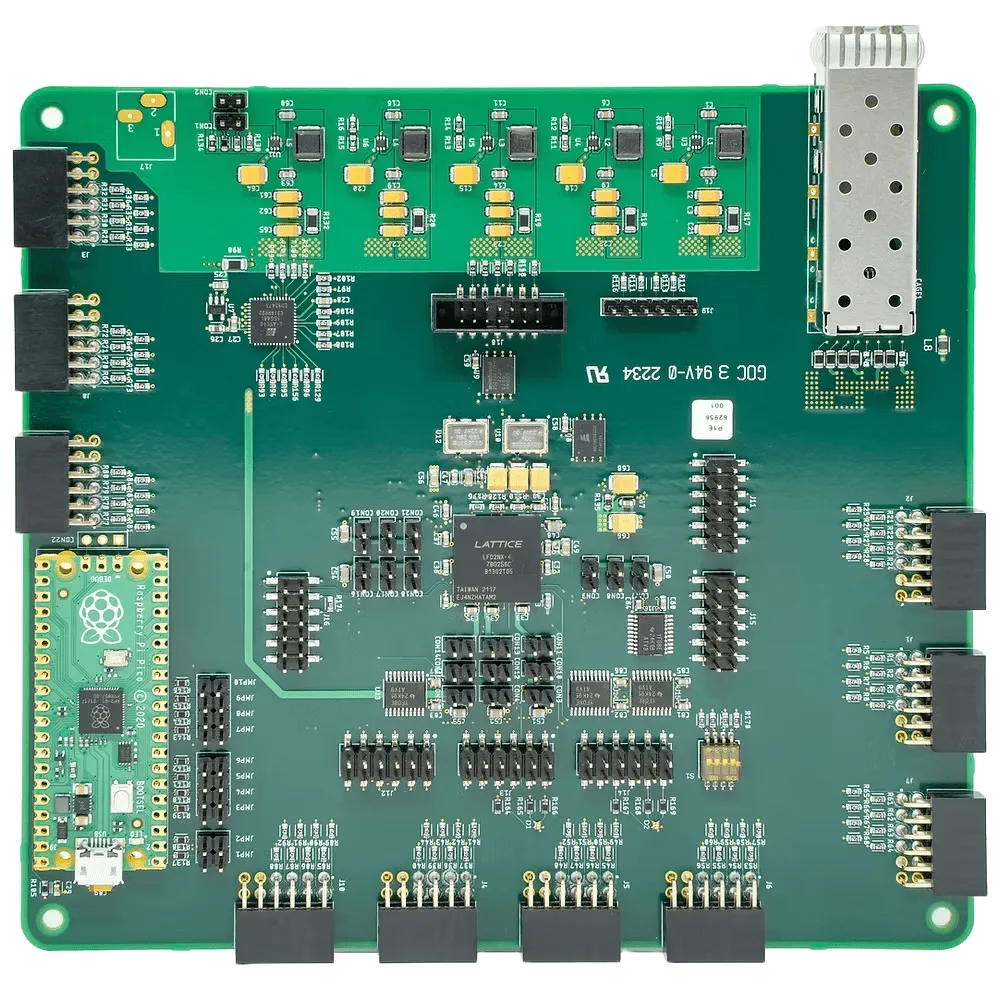
Specifications describe the product architecture. Availability, radiation configuration, performance and qualification evidence are confirmed during mission review. DANU product flight heritage is not claimed.
Board provisions
| Provided feature | Certus™-NX LFD2NX-40 |
|---|---|
| Provided feature | 80 I/O accessible via PMOD |
| Provided feature | 14 ADC channels including ADC reference |
| Provided feature | 128 Mbit NOR flash for configuration |
| Provided feature | 256 Kbit MRAM memory |
| Provided feature | 100 MHz oscillator |
| Provided feature | Lattice in-system programmable hardware management expander |
| Provided feature | RPi Pico |
FPGA details
| LUTs | 40K |
|---|---|
| BRAM | 2.5 Mbit |
| DSP | 56 |
| ADCs / Oscillators | Two ADCs and inbuilt 32 KHz and 450 MHz oscillators |
Positioning
| Equivalent device note | Commercial equivalent of the Certus-NX-RT device offered by CAES |
|---|
RISC-V
| Processor deployment note | RISC-V processors can be deployed on this development board using the Lattice Propel tool |
|---|
Unique RPi Pico capability
| Capability | Clock generation up to 65 MHz reference clock using the PIO |
|---|---|
| Capability | Communications emulation of a differential backplane bus |
| Capability | Communications monitoring and logging |
| Capability | Sensor emulation across the system and implementation of failure modes |
| Capability | Complex communications creation: implementation of a SpaceWire communication protocol between the FPGA and the Pico |
| Capability | Power management and monitoring of the power network and dissipated power under load or beam-line testing |
Application
- Deployment Cameras
- Temperature Control Systems
- Motor and Actuator Control
- Telemetry and Telecommand processing
- Health and Usage Monitoring
- Radiation Beam Testing for design proving
- Implementing Compression algorithms
- Implementing Cryptographic security
Unique RPi Pico capability
- Clock Generation — Generation of up to 65 MHz reference clock using the PIO.
- Communications emulation — Emulation of a differential backplane bus.
- Communications Monitoring — Monitoring and logging communications.
- Sensor emulation — Emulation of sensors across the system and implementation of failure modes.
- Complex communications creation — Implementation of a SpaceWire communication protocol between the FPGA and the Pico, providing a simple interface controlled over USB communication.
- Power management and monitoring — Monitoring the power network to control, monitor, and observe dissipated power under load or test conditions such as a beam line.
NEXT MISSION. NEW POSSIBILITIES.
What are you
building for orbit?
Bring us your mission constraints.
Let’s engineer the compute around them.