Earth observation
triage.
Identify clouds, coastlines, fire, flooding or changes in imagery to help prioritise frames for review and downlink.
IMAGERY → USEFUL FRAMES
SETANTA / AI & ONBOARD INTELLIGENCE
Turn sensor data into useful information, closer to where it is captured.
From image analysis to event detection, we explore AI workloads around the realities of onboard computing: available power, processing capacity and limited communications.
01 / APPLICATION AREAS
Start with the information your mission needs. Then shape the workload around the system that has to run it.
Identify clouds, coastlines, fire, flooding or changes in imagery to help prioritise frames for review and downlink.
IMAGERY → USEFUL FRAMESMonitor sensor streams for anomalies, threshold crossings and transient events, turning changing signals into concise alerts.
SENSOR STREAMS → EVENTSExtract and match visual features, and estimate pose from camera data, to support navigation processing.
CAMERA DATA → FEATURES & POSEAssess signal quality, compress payload outputs and prioritise data for transmission within constrained contact windows.
PAYLOAD DATA → PRIORITISED OUTPUTApplication areas for evaluation. Model performance, target support and mission readiness are assessed for each configuration.
Vertis has demonstrated its supported automated workflow with multiple computer-vision models on AMD FPGA hardware.
Vertis is under active development. Supported models and targets are evaluated individually; hardware execution and flight qualification are separate milestones.
Apply to the closed alpha03 / ADD HARDWARE TO THE STACK
Add hardware to your stack.
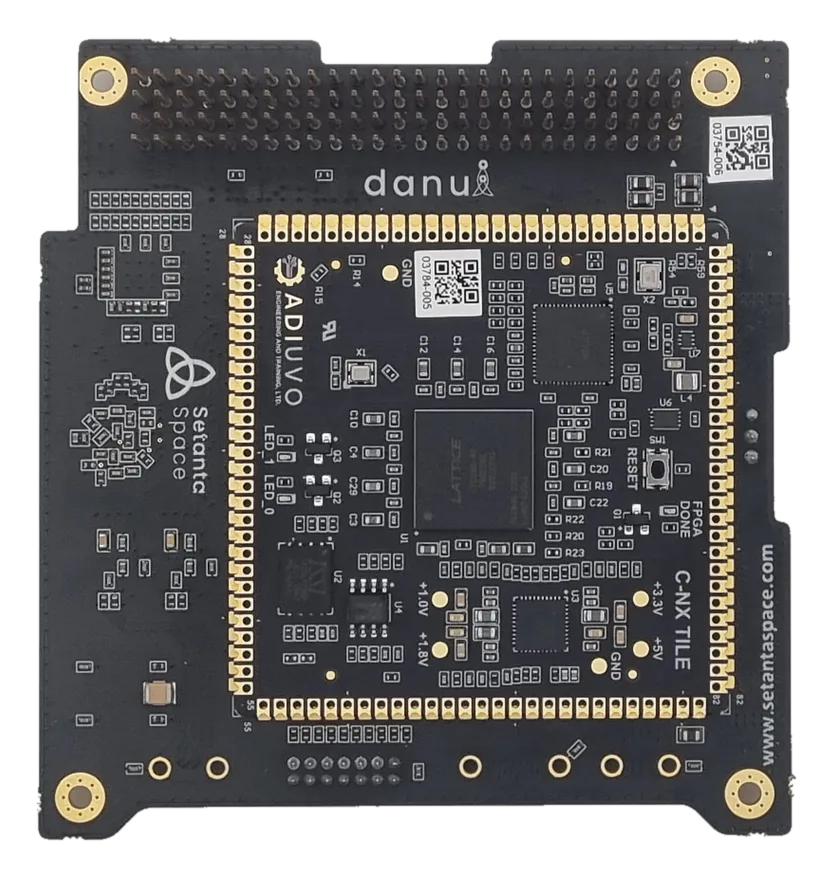
Explore our onboard computers and modular Space Tiles. Bring your AI model and system requirements, and we’ll help you choose a hardware configuration to evaluate.
Explore our hardwareYOUR NEXT WORKLOAD
Tell us about your application, the data it uses and where it needs to run. We’ll discuss a practical next step with your team.
Discuss an AI workload contact@setantaspace.com