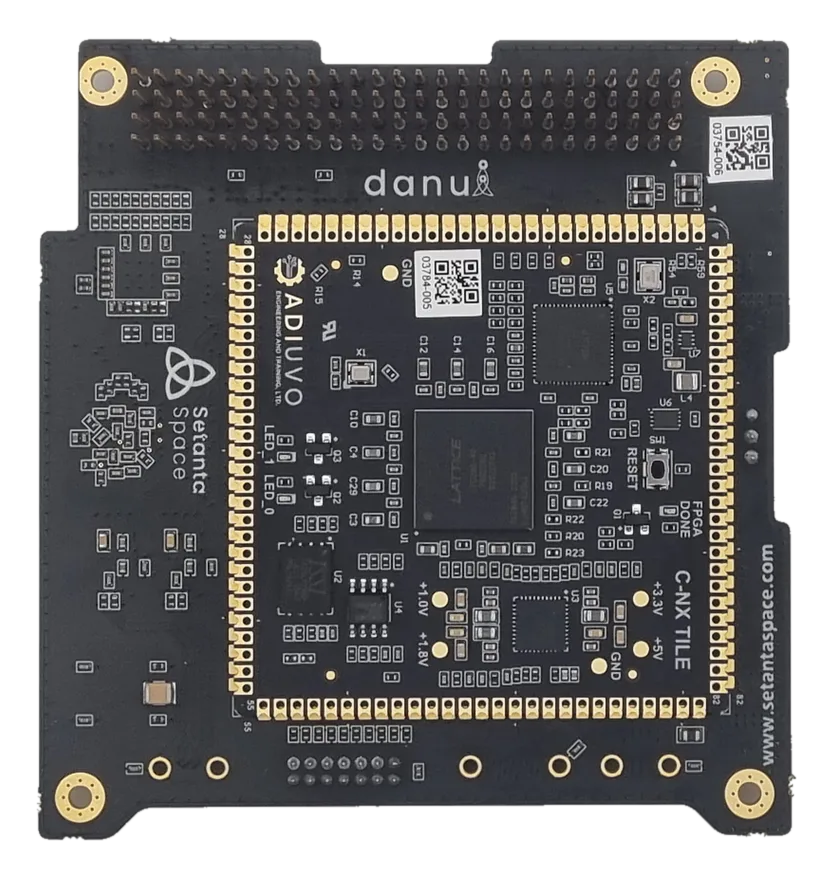
Modular onboard computer platform for small satellites, hosted payloads, and autonomous space systems. Built around Microchip SAMV71-family processing, integrated FPGA fabric, and modular Space Tile expansion.
Specifications describe the product architecture. Availability, radiation configuration, performance and qualification evidence are confirmed during mission review. DANU product flight heritage is not claimed.
Key features
DANU — Key features
Feature
Modular OBC architecture with optional compute expansion
Feature
SAMV71 / SAMV71RT / SAMRH71 ARM Cortex-M7 processing
Feature
Integrated FPGA for real-time processing, I/O bridging, and reconfigurable logic
Feature
Single-slot spacecraft form factor
Feature
Common software stack across COTS, RT, and RH variants
Feature
Designed for AI, autonomy, and high data-rate payload handling
Feature
Available in PC104, VPX and custom form factors
Main Processor
DANU — Main Processor
Processor Family
Microchip SAMV71 / SAMV71RT / SAMRH71
Core
ARM Cortex-M7
Clock Speed
Up to 300 MHz100 MHz for SAMRH71
Architecture
Deterministic real-time MCU suitable for FDIR and control tasks
Space Tile Concept
DANU — Space Tile Concept
Architecture point
True modularity for spacecraft computing through standardized, swappable computing tiles
Architecture point
Packages complex subsystems into a single module: FPGA logic
Architecture point
Packages complex subsystems into a single module: AI accelerators
Architecture point
Packages complex subsystems into a single module: Control and management logic
Architecture point
Packages complex subsystems into a single module: Power conditioning
Architecture point
Packages complex subsystems into a single module: Clocking and timing
Architecture point
Packages complex subsystems into a single module: Configuration and system interfaces
Architecture point
Packages complex subsystems into a single module: Mass memory
Architecture point
Dramatically reduces hardware development time and system integration effort
Architecture point
Simplifies avionics architecture by replacing custom boards with proven computing blocks
Architecture point
Enables rapid mission reconfiguration without redesigning the full avionics stack
Architecture point
Allows capabilities to be upgraded or changed late in the mission design cycle
Architecture point
Provides a scalable path from early prototypes to flight systems
Memory
DANU — Memory
Mass Storage
64GB eMMC COTS (RT/RH=32GB)Mass storage for filesystems, long-duration logging, and bulk payload data.
Critical Storage
64Mb / 8MB MRAM COTS (same for RT/RH)Non-volatile storage for critical logs, configuration, boot state, and other data that must survive resets and power loss with frequent fast writes.
Volatile Working
64Mb / 8MB Main SRAM COTS (same for RT/RH)
Non-Volatile Storage
512Mb / 64MB NOR Flash COTS (RT/RH TBD)Non-volatile storage for firmware, bootloaders, golden images, and recovery code for the SAMV71, plus triple-redundant firmware image storage interfacing with the Space Tile if there is an issue with the SAMV71 primary NOR Flash.
Platform positioning
DANU — Platform positioning
Integrated elements
SAMV71 / SAMV71RT / SAMRH71 MCU and Space Tile
Optimized for
CubeSat OBCs and payloads
Interfaces
DANU — Interfaces
Interface
100BASE-T Ethernet
Interface
SpaceWire
Interface
CAN / CAN-FD
Interface
QSPI / SPI
Interface
ADC
Interface
PWM
Interface
Dedicated PPS
Expansion
DANU — Expansion
Supported modular space tile type
AI accelerators
Supported modular space tile type
Co-processors
Supported modular space tile type
Custom mission hardware
Electrical & Mechanical Summary
DANU — Electrical & Mechanical Summary
Form Factor
Single-slot PC/104 modular spacecraft board, VPX, and custom form factors
Radiation options
COTS, RT, and RH options available
Application
CubeSat and SmallSat OBC
AI-enabled Earth observation
Space Situational Awareness
Autonomous navigation and GNC support
Payload control and data handling
Technology demonstration missions
Aerospace and Defence
NEXT MISSION. NEW POSSIBILITIES.
What are you building for orbit?
Bring us your mission constraints. Let’s engineer the compute around them.